
Journalist: Yuchen Wu; Photographer: Aoran Liu
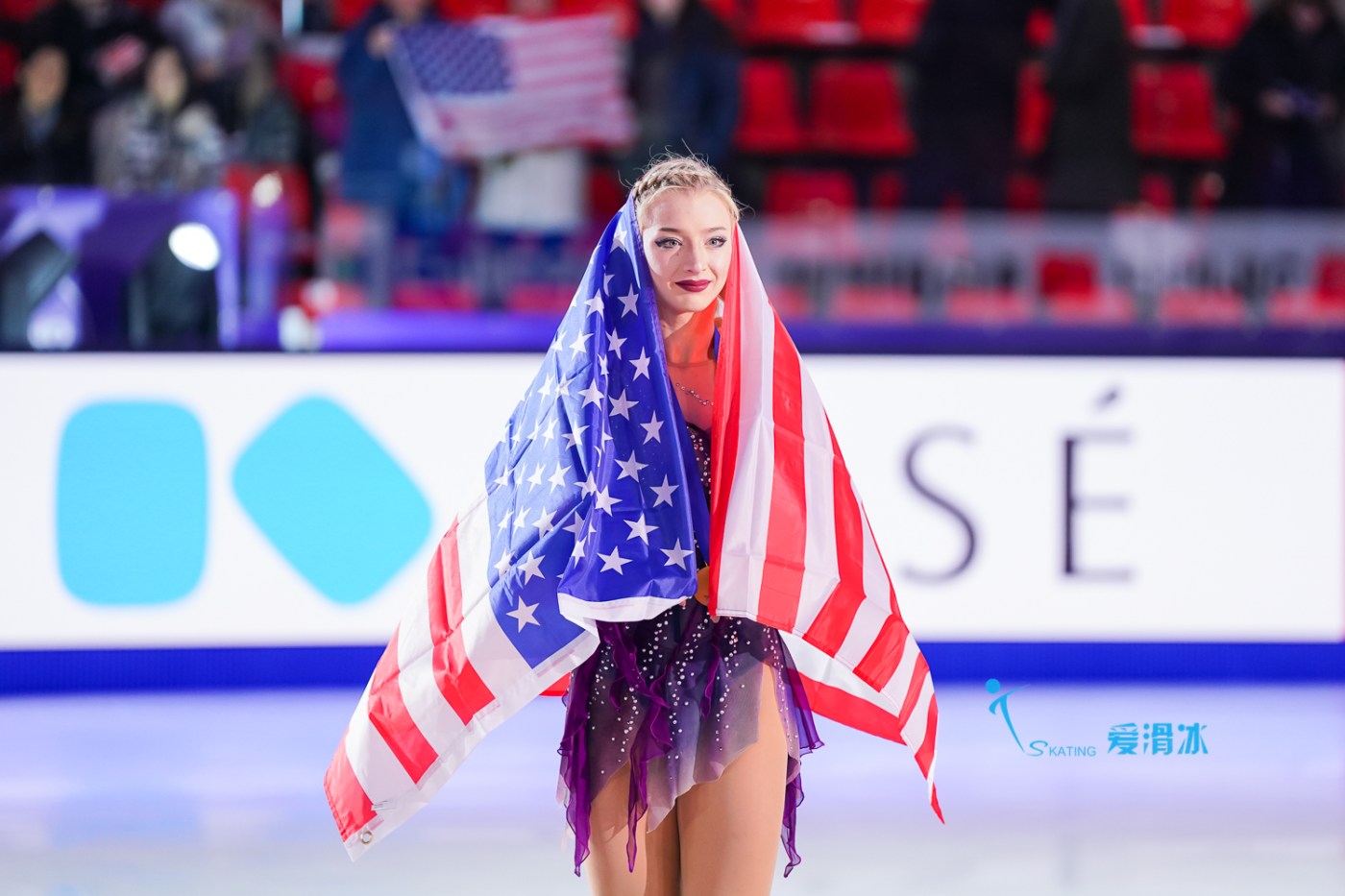
American figure skater Amber Glenn has been in excellent form this season. She has been undefeated so far, winning the Lombardia Trophy, both of her Grand Prix events, the Grand Prix Final, and recently successfully defending her U.S. Nationals title. At 25, and in her ninth season on the senior circuit, Amber has seemed to find a new wave of confidence and determination. Following her win at the Cup of China, Amber sat down with us to share her thoughts on the competition, her journey of overcoming challenges and finding confidence in recent years, her sense of responsibility as a role model for younger skaters, and her aspirations for the future.
At the Cup of China, Amber had a mistake on the triple flip-triple toe loop jump combination in her short program but successfully delivered all the elements in her free skate as planned. The excitement from both her and her coach was evident. ” I’m absolutely thrilled that I was able to show my competitiveness. It’s taken a long time to really hone that skill and I’m still working on it.”
Her two Grand Prix gold medals earned her the highest ranking heading into the Grand Prix Final, where she was the only non-Japanese skater among the six competitors. “Less than a day ago I didn’t know if I was going to be in the Final, and now we are talking about expectations. I’m just going to go there and try to do a little bit more than what I did in France and China, to make it a little bit better so that I can continue to improve for the Final, for Nationals, and hopefully for Worlds.”
Looking back on her two Grand Prix events, Amber noted that they were very different experiences. “Before Grand Prix de France, I had many weeks to prepare and was just ready to go. I was like let’s go, let’s go, and I had been doing clean programs for weeks. Then, there was a blizzard after I got back from France. I had trouble getting to the rink. I was tired, and it was a little more difficult between the two events. So, I had to rely a lot more on the mental side rather than just the training. I feel like I really showed myself that no matter what happens, I’ve worked hard so I’m physically ready and I just have to keep the mental side. “
Amber also attributes much of her recent success to her and her team’s objective and scientific approach to address her long-standing conditions related to ADD and ADHD, rather than simply reacting with negativity or emotion. ” Rather than ‘I’m not good enough. I’m not doing this right, we looked at it from (a perspective of) ‘my brain gets faster or my heart rate gets faster when I’m competing. So, we need to bring it down.’ I think looking at it from a very unbiased point of view really helped.”



At 25, Amber is considered a seasoned veteran in women’s skating. Her experience and her approach have made her a role model for many younger skaters, and she has always been looking out for and supporting those who she trains with. “Elyce Lin-Gracey trained with me for the Grand Prix circuit this season, and she is one of the hardest workers I know. She motivates me to continue to step up and be the role model that other skaters see me as. I want to show them that the advice that I’m giving is producing good results, and they see, oh, she’s doing well. She told me to be nice to myself. I should believe her. That motivates me a lot.”
“It means a lot (for the younger generation to see me as a role model).” Amber said. ” I had role models growing up, but they were so far away. I looked up to them so much, but I felt like they were so out of reach, and I am trying to bridge the gap. My training mates know that I’m not perfect. They know that I have my struggles and my issues, but I make sure that I learn from it and that I can give them my experience so that they don’t have to go through some of the harder things that I went through. And then I feel like when I give that advice, it’s also helped me to listen to it. So, I’m not just saying it, I’m actually trying to do it, and that’s helped me a lot.”
On the biggest piece of advice she has shared, Amber said “you are more than just your skating”. She felt like some younger skaters tend to want to define their value and who they are by what they can do. “There’s so much more to life and to the sport than just if you do your triple Lutz that day, and I think that’s a really big deal.”
Amber first competed at the Grand Prix Cup of China in 2017. Of the 11 skaters at the women’s event, only she, Wakaba Higuchi, and Mai Mihara are still competing today. Reflecting on this, Amber finds it crazy to look back. ” I look at some of the people I competed with there and they’ve gone on to have completely different lives. They’ve had successes and they’ve completed their journey. Sometimes I think, ‘Oh, God, I’m still doing this. This is crazy. I should go and get a real job or have a normal life. But then I’m having these successes. I’m still moving forward. It’s not in vain. So, it’s very surreal. But I am so happy to see that there are people like Wakaba and Mai who are still in this sport and still having success.”
Unlike many female skaters who peak in their teens, it took Amber some time to really figure out how to deliver performances consistently, despite having early successes as well. “Many skaters achieve their best results around 17 or 18, and that’s great. I wish I could have taken advantage of it more when I was that age, but I was really struggling with my mental health at that point, so to be able to find that wave again and go up, it’s amazing. And it’s been a long time coming. And I think it goes to show, hey, just because things might be coming down now, like the wave has kind of gone down, doesn’t mean it won’t come back up.”
For Amber, her persistence and desire to keep going also comes from a deep-rooted passion for the sport. “I enjoy the everyday. I really enjoy the training environment that I’m in. I moved to Colorado. I decided to go for it. And it was the first time I ever moved, the first time I ever did anything away from home. I really committed to doing everything I can to try and make this work and see what happens. And it’s been great. I really love the sport. I enjoy watching it. I enjoy doing it. I enjoy talking about it. I love showing people the sport, explaining it to them. So, I feel like that has certainly kept me in it. And I’ve been very lucky and fortunate to be healthy and in a good place both physically and mentally. So, as long as I’m in that space and I keep improving, I want to stay in it.” She said.
For the past two years, Amber has trained under Damon Allen and Tammy Gambill in Colorado Springs, both of whom she has known long before moving to train with them. This bond enabled a deep understanding and open communication about her needs, as well as heartfelt mutual respect and trust. “(Damon) has known me for a while and we’ve had great conversations about how my mind works before. He has worked well with my sports psychologist, and he just knows how to deal with it when I’m having a hard time. I feel like we really work as two adults who respect each other (about the knowledge) that we both have in the sport from years of experience. Of course, Tammy is part of my team as well and she is very experienced. She has been to multiple Olympics and had national champions before. She really keeps my head on straight and keeps this environment of really hard-working skaters. They just mesh really well, and it’s been great.”
Amber also shared a funny and heart-warming interaction with his coach Damon during Cup of China, which seemed like a quintessential demonstration of their relationship. “Before the six-minute warm-up of the free-skate, he asked how I was feeling. I told him I was shaking a bit. He just said, ‘nothing in this program is hard.’ In my head I was like ‘yes, it is!’ Of course, I knew what he meant, that nothing is hard for me because I do these elements every day, but it was such a funny thing to say, and I was giggling. Then, just before I went out to compete, he said ‘just do what you do every day’ which was totally true. He just instills that confidence in me and trusts me, and his trust has led to me to be able to trust myself, which has been a big, big part of my success. “
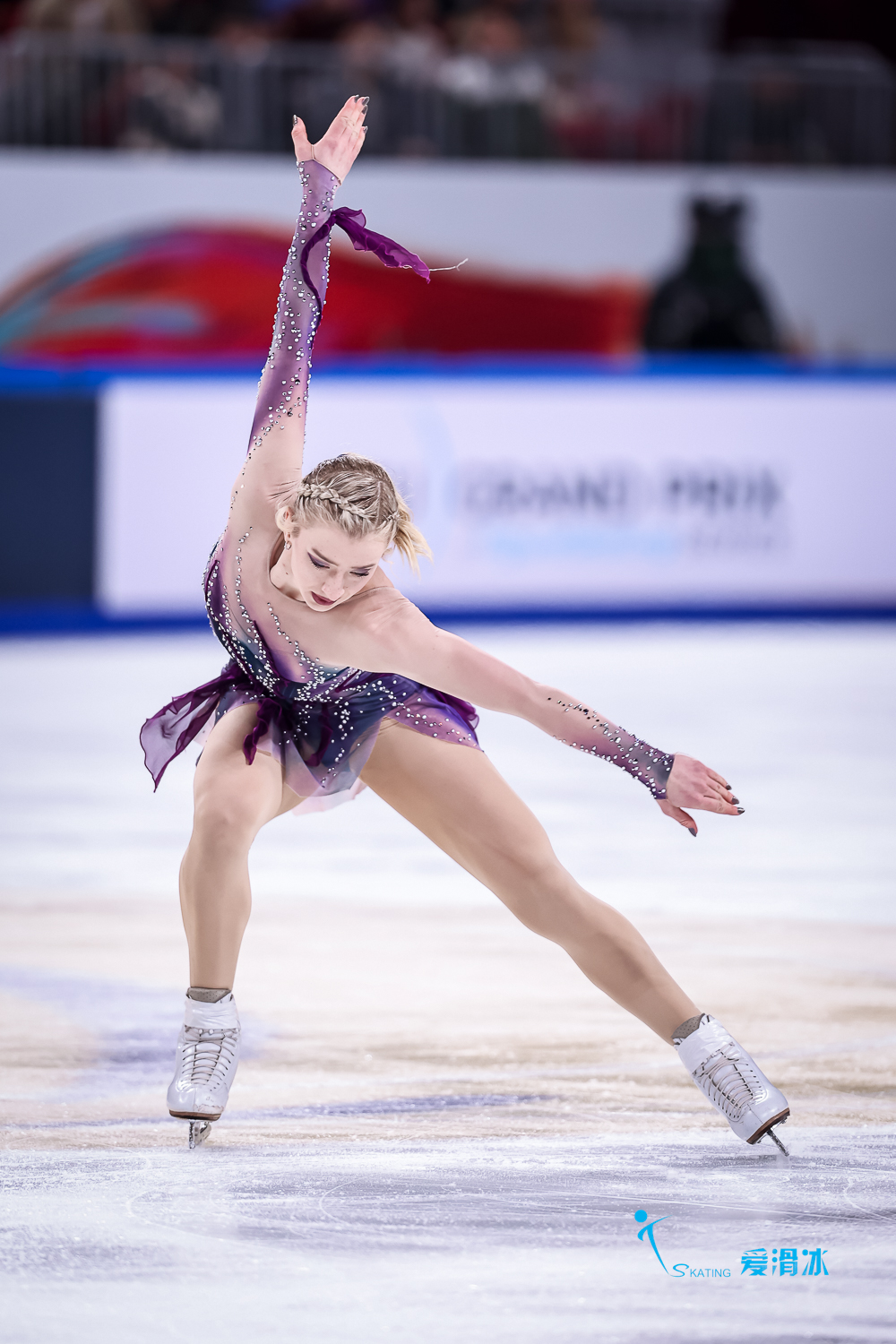
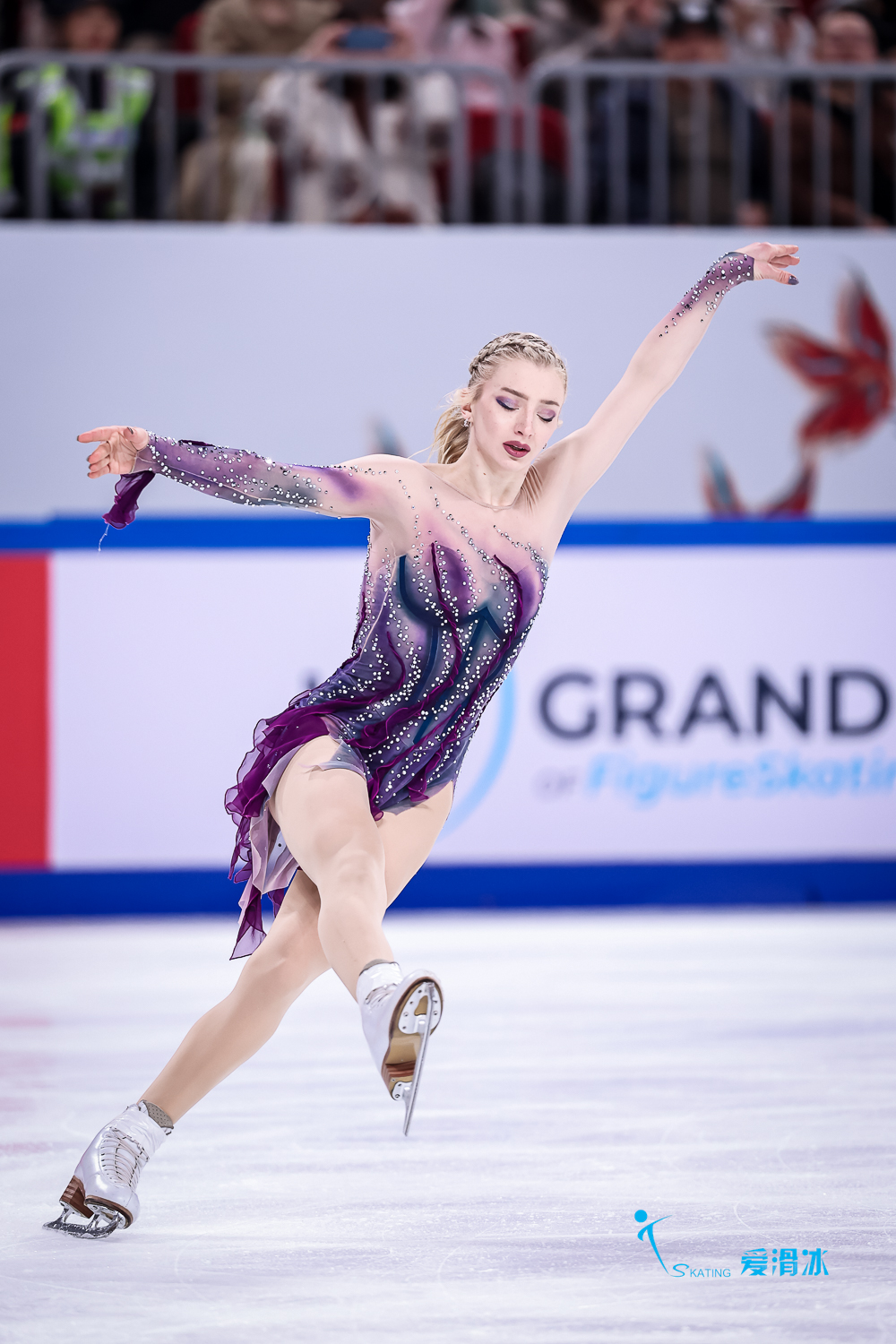

This season, Amber has two programs with contrasting styles, both of which highlight her strength. Her short program, choreographed by Kaitlyn Weaver, is set to Janet Jackson’s This Time. The program has a strong rhythm and fast pace, and this season, she added a triple Axel into the short program for the first time. At the beginning of the season, Amber found it challenging to balance everything, but she has now found her groove. “I have listened to the original version of the song so many times. I try my best to stay in the moment and really perform and I think I have a good time doing that. I still feel like I could do more in the future, for sure, but Kaitlyn has done such a great job and she has chosen something that is absolutely incredible and I’m so grateful that she found that piece.”
To Amber, Kaitlyn is not only a choreographer but also a friend. “I knew her through the competitive life and actually when I came out, we had talked about the process of her coming out too before she came out publicly. I feel like there was a connection there. We both have this mindset of wanting to break the stereotypical understanding of what women’s figure skating is, and so we’ve been able to work together on that. Sometimes she comes to me with these, crazy pieces that are way more elaborate than my short program right now because we want to do something new and exciting. And I’m like, I don’t want to go, you know, crazy, crazy right now, maybe at some point in the future. She has just got these incredible ideas that I’m trying my best to perform.”
“She’s just been absolutely wonderful and supportive. She really believes in me and sometimes she thinks that I can do a lot more than I can. It’s motivated me to try and push myself but she’s also taught me that I don’t need to be more than what I already am. I don’t have to do anything crazy to deliver a great performance. I just have to do what I’m capable of doing.”
Compared to the short program, Amber’s free skate is grander, calmer and more elegant. “My choreographer Katherine Hill and I wanted to find something that was strong and powerful, but beautiful and kept me calm. That was a big thing for me, trying to keep things in a good rhythm. She eventually found several pieces that were put together and she and her husband cut the music. My first thought was a siren-like beauty, almost like water. I really try to capture that as best I can. I feel like I could do a lot more on the component side and the performance side. I’ve been very focused on the elements and the technical side this year.”
This season, Amber has incorporated a triple Axel into both her short program and free skate, giving her higher base value. Over the course of several competitions, she has been pretty consistent with this jump. She mentioned that she had played with it when she was younger, but actually began working on it in the summer of 2020, and it took a couple of months before landing it for the first time in training. However, the journey to success in competition took much longer, until 2023. and in 2023. “I think it was definitely a mental thing that I had to overcome. When I finally did it in competition, I feel like a whole new wave of confidence came over me.”
With the World Championships returning to Boston this March, Amber is eager to compete as the home crowd cheers her on. ” I remember watching the Boston Worlds in 2016, going as a fan, and to think that nine years later I’d be going as a competitor, it’s just overwhelming for me, and I can’t wait.”
 iskating.media
Leave a comment